Showing posts with label design. Show all posts

Sunday, May 16, 2010

Re-do your space!

It takes a little bit of effort to energize and bring more life to your daily spaces... so why wait? I'm going to start with the work spaces today.. and more to follow soon!

Work Desk :
~you have a pile of files and papers - get really cool paper/file holders or separators. Your work stays organized, and desk looks cleaner.

~wires - even though we are moving towards wireless technology, we are still going to need them to charge our phones and laptops. Get a round shallow basket or a big mouthed mug and put it close to the socket. Wind up the wires and put your chargers in it, when not in use.

~get note-clip holders. Let them hold your appointments for the day, your favorite photos or quotes that you live on. One looks too lonely, so make sure you get about 5-6 of them. Cluster them randomly but close to each other.

~get rid of boring calenders, after all you have to look at them all year long! Get customized photo-calenders with photos you or a family member has clicked. Its all become very easy with the internet now. Really worth the effort.. and you don't necessarily have to be a pro to make one!


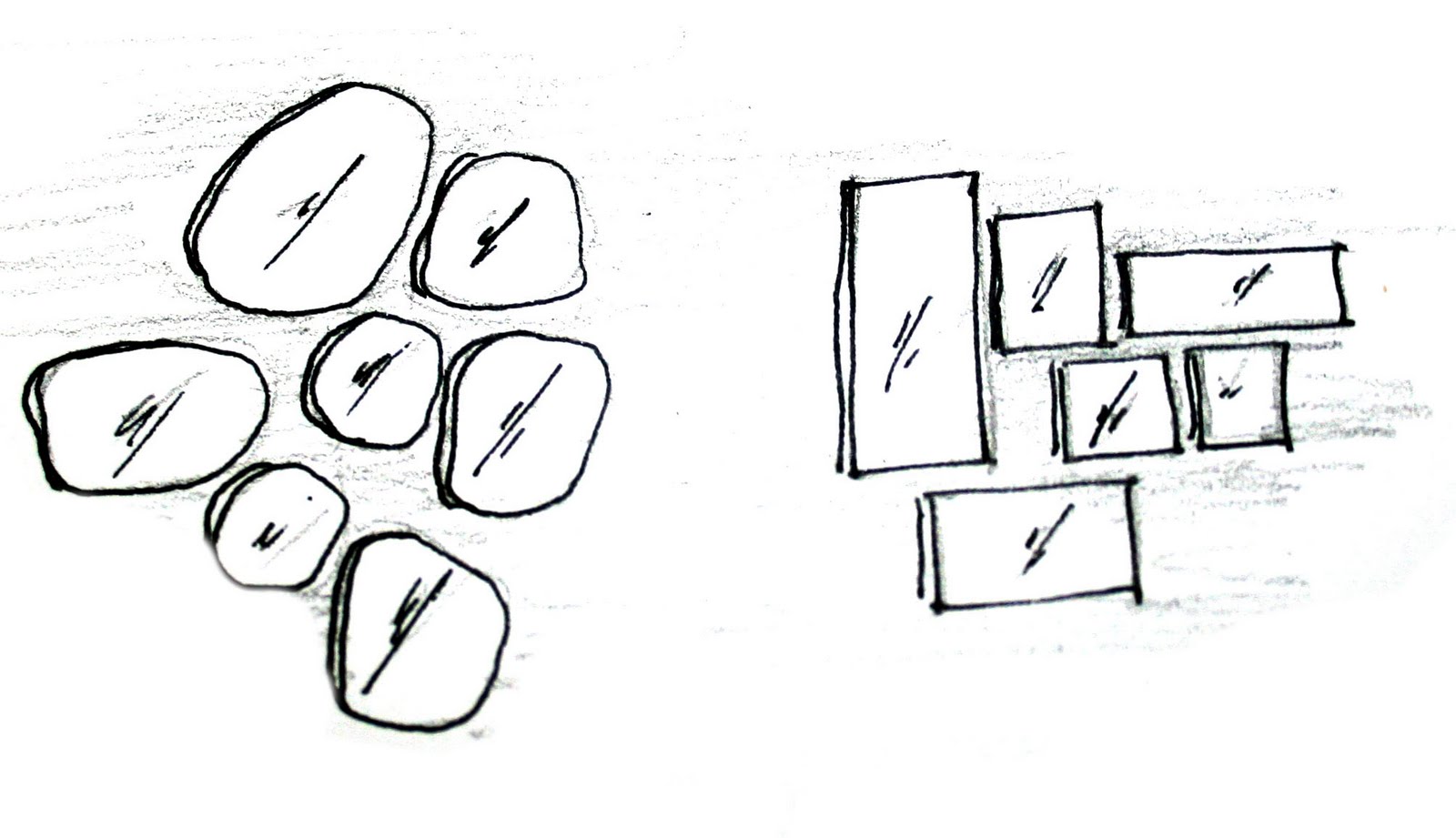
~a soft-board is too cliche - get small mirrors on the wall next to you!
Bulleted List

Monday, April 26, 2010

Design like a child

Children are the most creative in this world, for the simple reason that they are not influenced by anyone. Their creativity comes from the modest joys of life - color, sand, clay, puppies and other things that most of us have stopped noticing.

Ask a child about his artwork once he is done. More often than not, it will be an exaggerated story expressed with animated hand-actions. They like everything to be larger than life and there is a reason to that too. When you look at the world from their eye-level, everything seems l a r g e…the people around, the cars, the furniture, the trees, etc. They believe that most things are larger than them and thus, like to portray a lot of 'big' things in their stories. Notice the words million, zillion, big, thousands, huge when they are telling you about something.

However this also makes them feel more connected to small scale details which we would tend to miss out on... crawling under the table, playing with low-height switches, patterns on the floor, insects to name a few.
Thus, it becomes important for designers to work in the "child-scale". A simple experiment to experience this would be to get on your knees and walk around the room…the ceiling will feel higher, the window inaccessible, the wash-basin too high to reach, the door handle unreachable and the dining table chair too low for comfort.

An essential thing to note when designing for children is their growth. If the same child is going to use the space for a long timeframe (5+ years), like a bedroom, then the space needs to be able to accommodate the child's needs through the years. However, in the case of a school, where a constant age-group of children is utilizing the space, the overall design can be more permanent.

Two most important people to connect with, while designing a space for children are the children themselves and the adult concerned (parent or teacher). If you are neither of the two, the best thing would be is to spend time with both. You will learn more than what any book can tell you. Participation of users in design just helps us learn and design better!

Tuesday, February 10, 2009

Designing Schools


Every city, every village is flocked with buildings/spaces for their different purposes. Amongst the many, a school is a must. Even the most simple of villages will have a space, even if it is under a tree, for a school. The student-teacher relationship has dated back centuries. It is considered by many a holy place where the future of the children and the world is shaped. The space where knowledge passes from one generation to the other, thus becomes an important one.

The trend in school design these days is "Interactive Design". The space that houses the school should help engage the students, teachers and visitors alike. The architecture and interior design becomes successful when it becomes a part of the teaching syllabus. This is a contrast to the traditional classroom style teaching which is prevalent in all schools around the world. Research shows that children can learn better by 'doing' than by 'listening'.
So, how can designers help engage the occupants with the building in a positive manner? This question can be answered if designers engage in a dialogue with the educators and children. It will really help if the designers understand the syllabus and try to bring about a change in the teaching style. For example if students were to learn about solar energy, they should be able to walk up to the roof which has solar panels. Other concepts like rainwater harvesting, nurseries, glass house, wind/water too can be incorporated in the design of the school itself. It also helps integrate nature into children's daily lives which will help ward away Biophilia which is common amongst children today. It will help them experience the concepts before getting an explanation on it.
The environment of the school should be bright and positive. It should be an atmosphere where children can engage with one another. Social interaction is as important as knowledge, and hence it is necessary that gathering spaces within the school are well designed and are numerous in number with varying sizes.
Children are our future. What we shall give them today, we shall get tomorrow. It is our duty, being in any profession, to give the best to children without expecting immediate gains. We have to think about new solutions for the future, and for that we have to understand human needs, values and desires.